May 3, 2025 Nature Journal
- Nola Marley

- 1 day ago
- 3 min read
5.3.25 (1:45pm)
Holden, Maine
Sunny and partly cloudy: 69-70 degrees
Hearing the hummingbirds zooming to the nectar, and the brown-headed cowbirds chittering from the roof with their tinkling voices, ringing like bells, I can’t help feeling a deep sense of peace. Happiness and peace, as Zen Master Thich Naht Hanh might say, is not only found in nature, but is our nature.
While Albus Dumbledore might suggest it can be found “even in the darkest of times, if one only remembers to turn on the light.” Though the feeling it instills is much the same, the image may clash with the buddhist dharma more than extend it. The dharma would have you believe that suffering, not happiness, is the thing of substance, as suffering is said to be caused by attachment and desire. When you want to find true happiness, in this sense, removing the elements of suffering is the first and most important step. It would seem Dumbledore’s additive suggestion conflicts with this reductive philosophy, but if we look at his metaphor again, we might understand that he is saying in order to find happiness, you must remove the darkness.
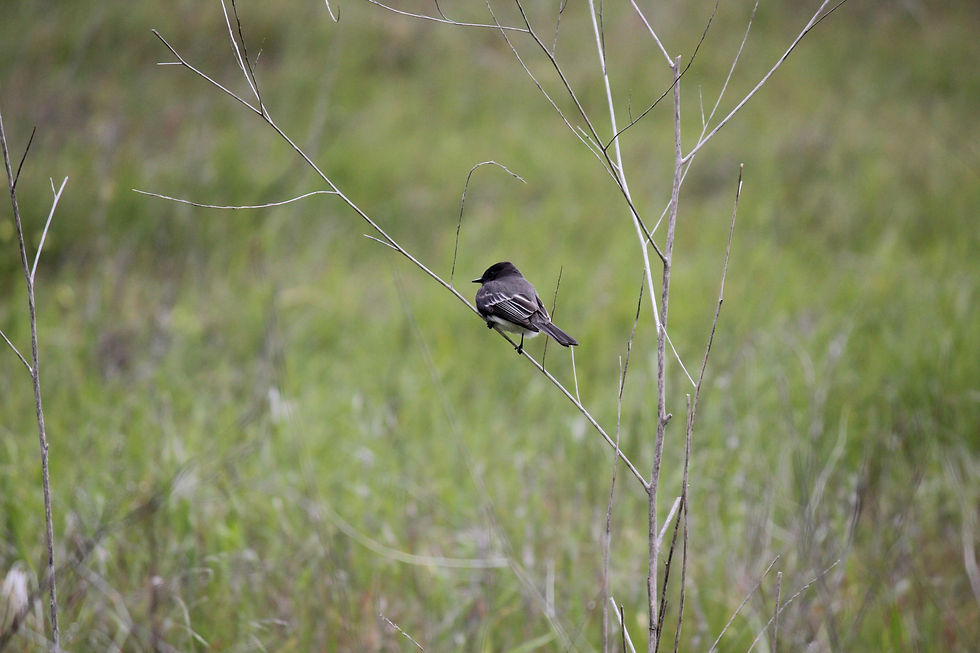
But is that the same thing as adding light? In my backyard, the birdsongs are my light, my source of happiness. I notice I feel much less heavy when I can hear their songs than when I can’t, even if I'm in the exact same place at a different time. Their presence - or lack there-of - impacts me on such a subconscious level that it makes me wonder if I may be feeling it on a physical level as well. One would hardly bat an eye at the theory of humans co-evolving alongside our non-human neighbors, it’s practically baked into the definition of evolution: an organism adapting to its environment. The birds are one small but almost omnipresent part of the homo-sapien’s environment. So when I hear the conversations of the Chickadee and the Song sparrow symphonies, and they make me feel a certain way, is this not co-evolution in the flesh, (or rather, in the song)?
Evolution doesn’t have any other goal but to continue survival, and yet why would song-birds ensure my survival enough to trigger a certain positive emotion within me?
Why after a long hot day of working in the garden, I relax by thrusting my toes in the grass and leaning back in my lawn chair? To beat the hot summer heat, why do I drive from the shade of the pine trees to the bare and open beach, crossing hot sand to plunge into the ocean, not escaping the sun but inviting the cold? And why do I turn down the radio, playing hit song after hit song, to listen to the masterpieces Mother Nature has composed for me?
There are answers all over the place, but I’ve found so far that the zen buddhist teachings to be the most concise, even if not complete. Maybe one day science will tell us something new, though at least for now we know that if we need a pick-me-up, the birds will grant us that. The bluebirds in my neighborhood give me the most joy with their petty family squabbles over the mealworm tray. Even when they’re bickering over who gets the biggest worm, I can’t help but smile.
Definitely more to be studied here.


Comments