Postcard #3: Lessons from Mouna Farm
- Nola Marley

- Aug 17, 2021
- 7 min read
Updated: May 5, 2025
Where to begin?
So much has happened in such a short amount of time, so many beautiful and powerful moments - to try to compile them all in a single blog post would be an insult.
I suppose I’ll start by first giving a rundown and a quick update as to where we’re at now.
We arrived on Oahu on June 23rd, spent a week living the tourist life, then worked on a farm on the west side of the island. We stayed for the month of July, making amazing friends, seeing new ones come and old ones go. Now we’re working at a hostel on the North Shore, called Backpackers Hawaii, doing housekeeping in exchange for a bed. (More to come on that).
In my last postcard, I explained a bit about my introduction to the farm we were WWOOFing at, Mouna Farm, which itself deserves an entire book devoted to it. Even though we were only there for a month, it felt like a lifetime, because we made connections so deep that it felt impossible to us that they were formed in a couple of weeks.
Mouna Farm is in Waianae, referred to as the “wild west of Oahu”; a dry and arid small town, populated mostly by native Hawaiians. Due to the systemic racism against indigenous peoples, poverty is rampant. And where poverty goes, crime follows.
The farm was well respected in the community, for the work that they do to feed the people and to spread awareness of native culture, so we all felt safe being there. Though there were some nights where gunshots rang out in the distance, us WWOOFers were all tucked away safe and sound in Shady Grove, a reclusive area of the farm reserved for the WWOOFers to set up camp.
All of us, with the exception of Jasper, were young women around college student age, but even still we didn’t feel unsafe venturing out into town. Because despite it’s pitfalls, Waianae is filled with aloha. We all felt it at one point or another.
One day, Jasper and I walked about 20 minutes to the laundromat. It was a dingy little place, exposed to the open Hawaiian air, and lined with washers and dryers as you might expect. When it came time to switch over our load, a local woman, without us even needing to ask, showed us one of the dryers she said worked the best, and gave us a few of her dryer sheets. We kept the extra dryer sheets in our tent afterwards to keep it smelling nice, and every day when I woke up I thought about how kind she had been.
That is the true aloha life. Giving.
One of the major lessons we learned from the farm was the art of giving. As previously mentioned, Sooriya (the owner of the farm) follows what he calls “the religion of the heart”. He says that other religions have “failed” him, and that what he truly feels needs to be conveyed via spirituality is love and compassion for others. He always asked us to do our work with our hearts, fully embracing and being present with what we were doing. He impressed upon us the importance of giving, always giving to others. This is what aloha is about.
Whenever a new person came to the farm, we were told to offer them food and water. Originally, we just thought this was just about hospitality. But one night, Sooriya invited us over to his hut to show us a documentary he was a part of called Ola. Directed by Matthew Nagato (whose step-son became a good friend of ours during our time there), Ola is about the healthcare system in Hawaii, and how societal factors influence public health (Here’s the link if you’re interested). One very key element they explore in the film is food insecurity, and lack of access to healthy, organic foods. That’s where Mouna Farm comes in. Mouna is an organic farm that provides organic, healthy foods to the community at a low-cost. (Believe me, I ran those deliveries, I saw the prices, it was amazing they could afford to give so much away at such little cost. Mouna is a non-profit, so all the proceeds went straight back to just keeping the place running. Everything was done by volunteers, even the buildings and the artwork on the property.)
What I learned from that film was the deeper meaning behind offering food and water to our guests. We offer it because we never truly know the last time someone ate. Waianae, as a town with a critical poverty problem, has major food insecurity. Being able to offer organic food to anyone that came on the farm, invited or otherwise, was a blessing in itself. I can’t begin to express how much I love and appreciate this place. It will always be a second home to me.
Another huge piece to my experience of the farm is the people I worked with. On average, there were about 9-10 WWOOFers total at any given time. I think in total we worked with about 15 different WWOOFers over the course of our stay. Plus, there are the permanent volunteers on the farm: Peter, Sonia, Maryann, Phoenix, and obviously Sooriya. They were loosely referred to as the “elders”, but mostly by way of explaining them as permanent volunteers. No one there was paid, everyone worked for the farm out of the kindness of their hearts (love and compassion are the great roots of peace).
I spent a lot of time meditating on my work ethic and what it meant to me. My perspective on work culture is saturated with narratives of underpaid and overworked employees, and as a result I've always prioritized separating my personal life, time, and my heart from my work so as to not get trapped or taken advantage of. Yet here, I was being asked to not only work where I lived, but do work with all of my heart and emotions present. To make seeds grow and thrive, to harvest fruit carefully and gently, to sanitize the wash station so we could keep our community healthy, I had to sacrifice a lot of my time, completely unpaid, and do it with my heart fully present. I couldn't check out. I couldn't go on autopilot. I had to be awake.
This scared me. There were plenty of days where I worked longer than 6 hours (our contractually agreed upon time) and I worried that I had no control over my time anymore. That I was giving too much and not seeing a return. I watched my friends get sun stroke in the middle of the main field and keep hoeing, digging, planting, or harvesting. I spoke up when I could and told them that they should give themselves a break, but they said that the work needed to get done and so they did it. I couldn't understand why they would sacrifice their physical and mental wellbeing just for some plants.
Eventually, I came to realize that working with your heart means that you sacrifice everything, even if it hurts you in the process. That's just what you do. In the hottest time of year, on the driest part of the island, the plants need us to water and care for them. They may not know what you've sacrificed, but they know when you show them love. It can be easy to see them as beings capable of taking care of themselves without you. It can be even easier to think of them the way you think about other people. But they're much more willing to ask for help when they need it. They are so much more sensitive to love and emotions.
It’s been observed that the molecular structure of water crystals can change shape depending on the frequencies they're exposed to; this is why they say it's good to talk or sing to your plants. Mouna helped me understand just how intune plants are with our emotions and our intentions. Even in little ways. And it doesn't have to be about spirituality or energy, your intentions and your motivations can go a long way into how plants react to you. If you put your whole heart into taking care of them, you are more likely to water them often, watch out for weeds or pests, put them in the best sunlight, and keep them happy. If you're not putting in your heart and energy, or as much as you can, you might forget to water them once or twice, or neglect a few weeds here and there. These little things can make a huge difference in the health of the plant.
Being able to work with all your heart is something that extends beyond just farm work. Whatever work you do, I encourage you to really think about why you're doing it and what impact you have on the people you work with and for. Whose life are you making easier by doing what you're doing? Whose day are you going to make by helping them out? What impact are you having by showing up today?
This doesn't mean that you should allow yourself to be manipulated or unappreciated in the workplace. You can still experience that and put your heart into your work. Doing so might not change how others treat you, but it can change how you view yourself and the work that you do. You'll start to be more proud of your efforts, and the things you seek to improve will become better because of it.
If nothing else, Mouna has brought me closer to my own emotions, and has helped me think more about my place in the universe, in the world, in my own life. It's brought me new perspectives and challenged existing ones. It taught me to give the very best of myself to others, and show compassion to all.
This is what it means to have aloha.
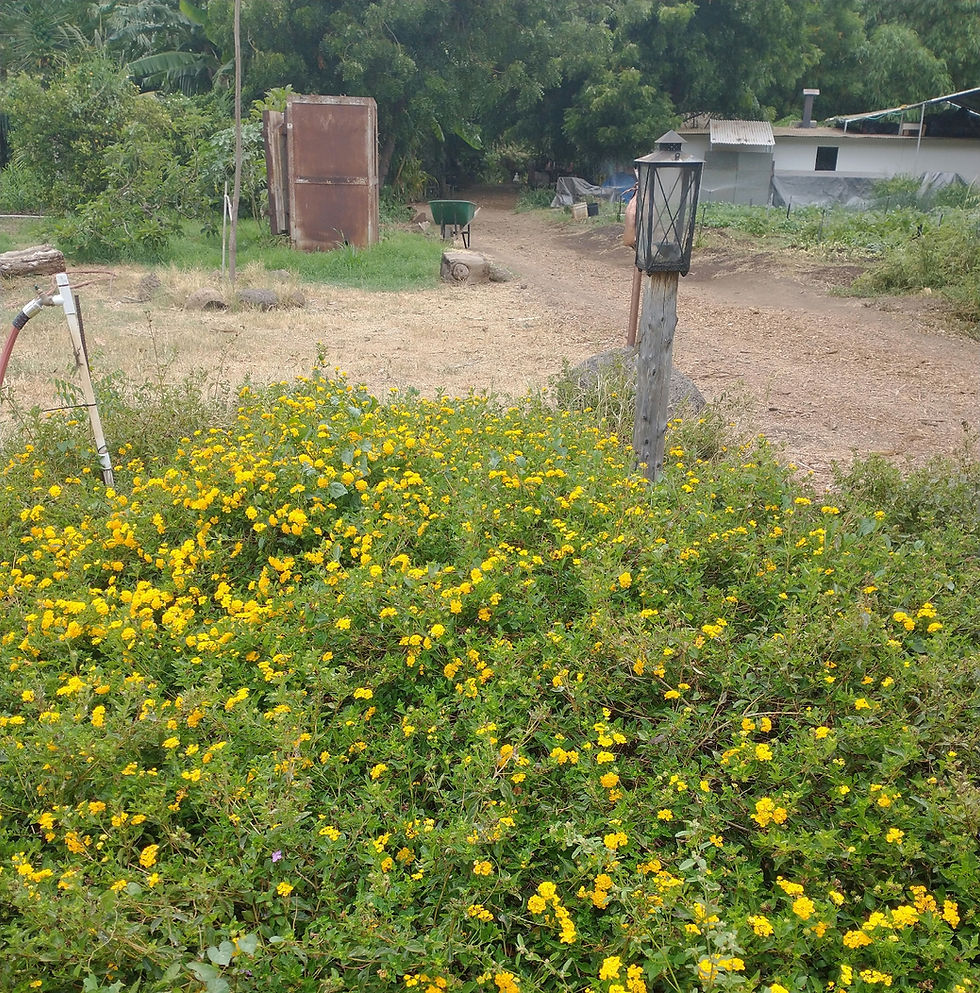
(Photo details: this shows the "pico" lantern at the entrance of the farm, letting others know we are here, a beacon for visitors to feel welcome.)


Comments